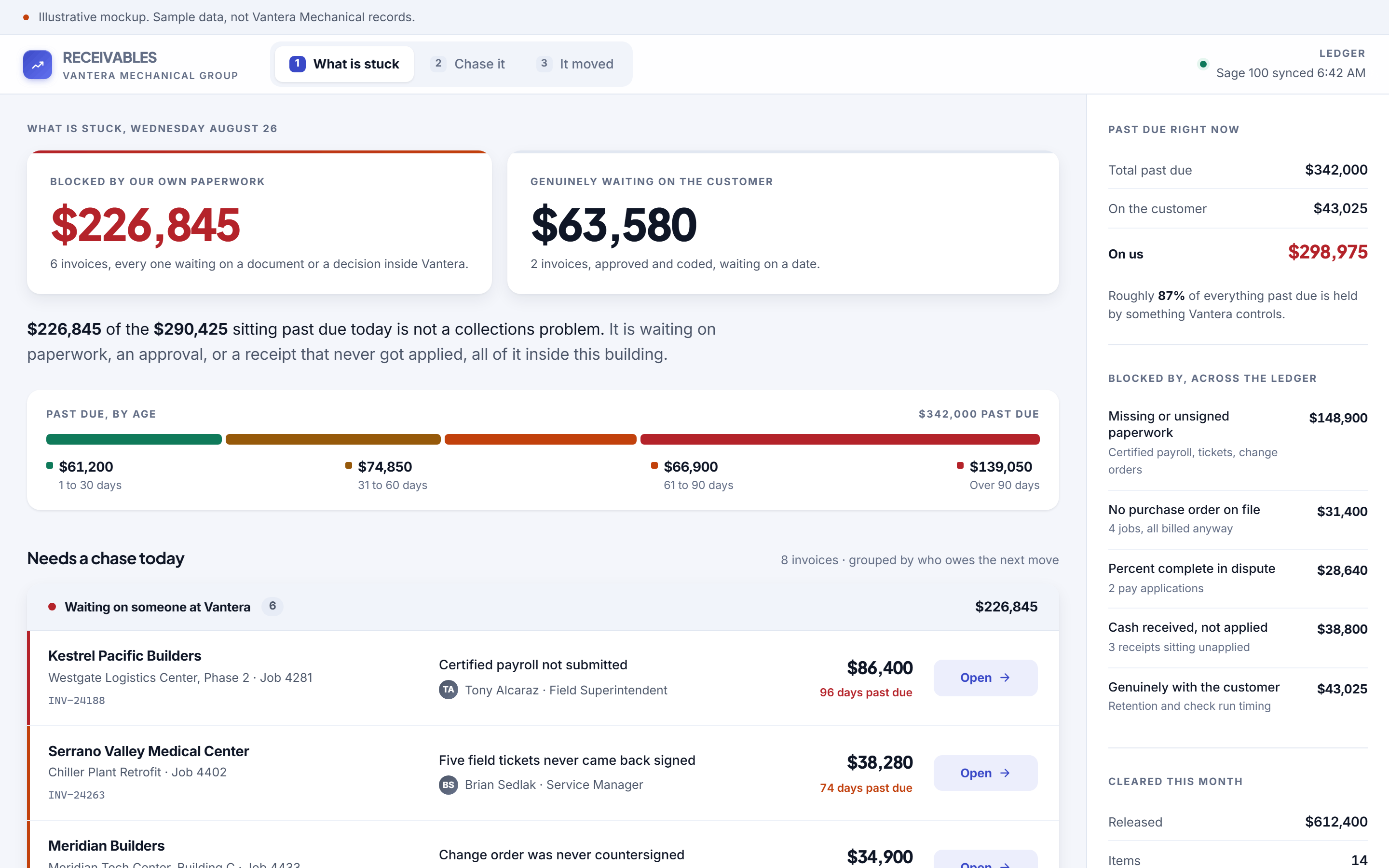
The aged receivable is mostly our own paperwork
Most of what sits past ninety days is not a customer refusing to pay. It is a document nobody inside the building has produced yet.
Waymark Lab builds custom software that improves the business processes your team still runs by hand, then uses AI to show you exactly where the time and money go.
Illustrative sample data.
When they take a vacation, the schedule, the billing or the renewals quietly stop.
Orders, invoices and job details get copied between systems that do not talk to each other.
An expired certificate, a missed invoice or a stalled order is found when it is already costing money.
If any of these sound familiar, the answer is usually software, not another hire.
We take on any business process that runs on manual work. These six come up most often, and every build is shaped around your process, not a template.
Assign the right person to the right job without the whiteboard. Skills, certifications, availability and customer rules are checked automatically, and changes reach the field in one step.
Schedules that hold up through a sick day or a vacation.
Invoices go out when the work is done, not when someone finds time. Payments are matched to invoices automatically, and the paperwork holding up payment is flagged before it ages.
Faster billing and fewer write offs.
Every certificate, license and required document is tracked against its expiration date. Reminders go out before anything lapses, and the record is ready when an auditor or lender asks.
Nothing expires without warning.
Stock levels, reorder points and purchase approvals live in one place. Shortages surface before an order stalls, and every purchase goes to the right approver.
Fewer stockouts and no surprise spending.
Staff, provider and vendor files stay complete and current, with renewals tracked automatically. A lapsed credential never stops billing or holds up a job.
Complete records without the chasing.
We analyze your own transaction, schedule and billing data to find where work stalls, where errors repeat and where money leaks. You get a clear list of fixes, ranked by what each one is worth.
Decisions based on your data, not guesses.
Every solution connects to the accounting, operations and document systems you already use, so nobody retypes anything.
Swipe the diagram to see both sides.
Data copied between spreadsheets, email and separate systems. One person holds it together.
One workflow that collects the data, checks it, sends the reminders and shows your team only what needs a decision.
You see your own process working before you commit to building it.
We walk through the process with the people who run it, map every step including the ones nobody wrote down, and review your data to see where time and money go. You get a fixed price before any building starts.
Instead of a requirements document, you get real screens running your own process. Your team tries it, we refine it, and the price stays fixed unless you change the scope in writing.
We move your data, train your team and run alongside the old process until everyone trusts the new one. After launch we support and improve the software as your business changes.
It reads what arrives, drafts what goes out, and flags what is missing before it becomes expensive. A person stays in control of every decision.
Certificates, licenses and delivery photos are read into fields, with weak reads flagged for a person. Confirmed in one click instead of typed again.
Follow ups, notices and statements are assembled from the actual record, ready to edit before they send and logged after.
Names the items that will get a packet rejected, and why, before it leaves the building.
Spots repeats a person cannot see from a list, like the same claim at the same address or a count that is always short after a delivery.
Every suggestion shows its basis and can be overridden in one click.
Working concepts that show what the software behind a manual process looks like. The companies and data in them are invented, and every screen says so.
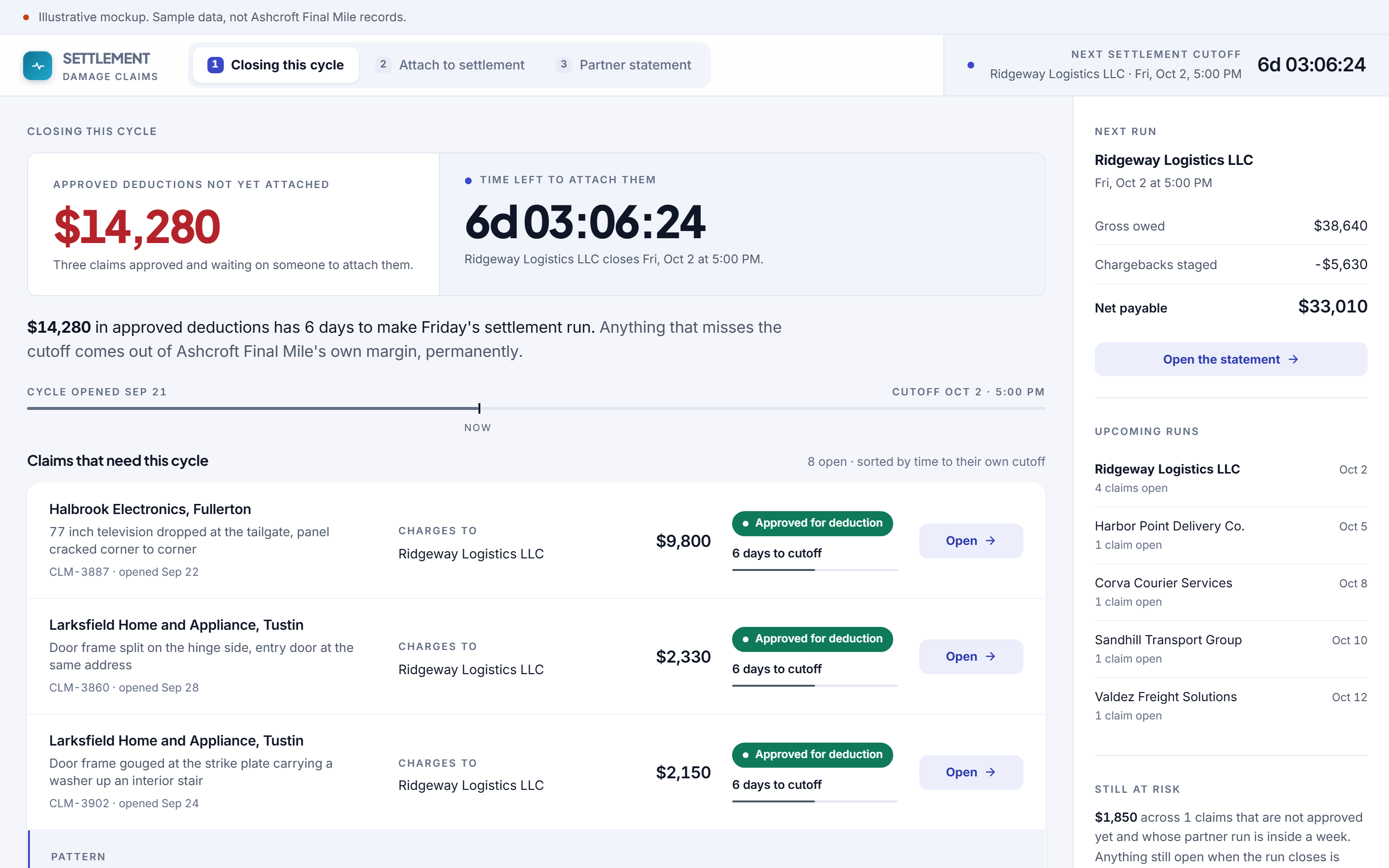
Most of what sits past ninety days is not a customer refusing to pay. It is a document nobody inside the building has produced yet.
Damage claims are worth money only until the carrier settlement run closes. After that the loss is permanent and nobody sends a reminder.
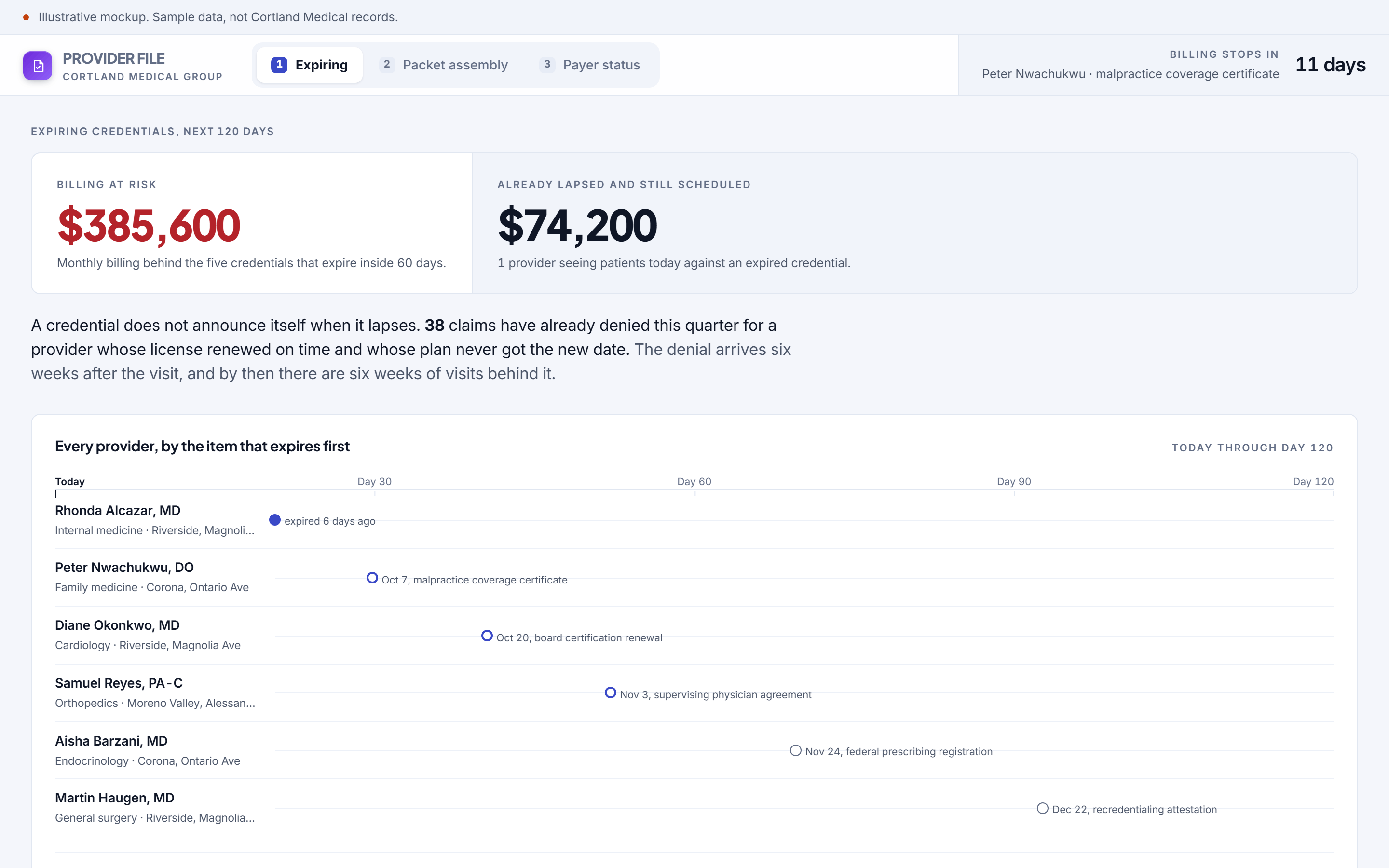
Nothing announces a lapsed credential. The claim denies six weeks after the visit, and by then there are six weeks of visits behind it.
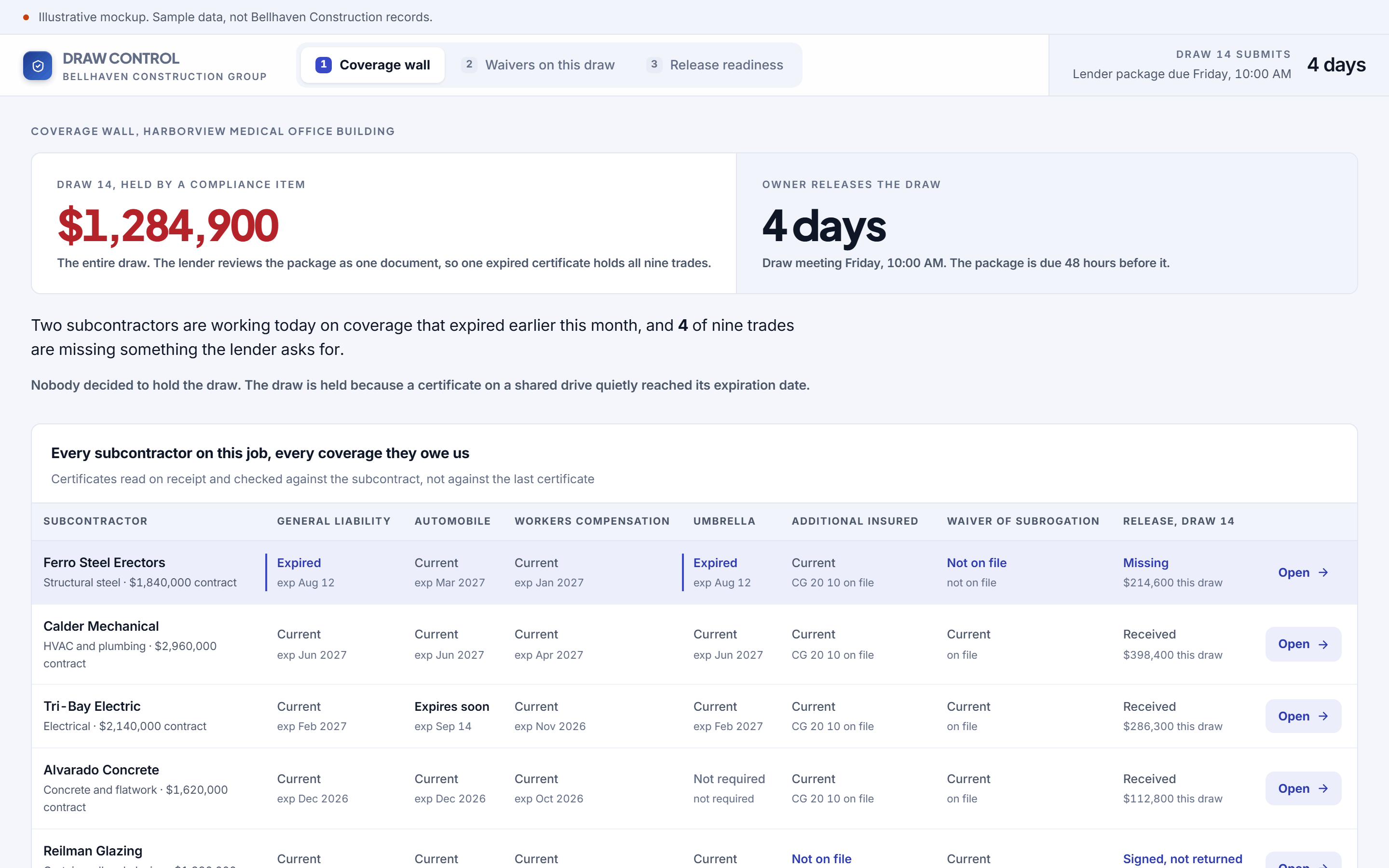
The lender reviews the draw package as one document. A single subcontractor certificate that expired mid month holds all nine trades.
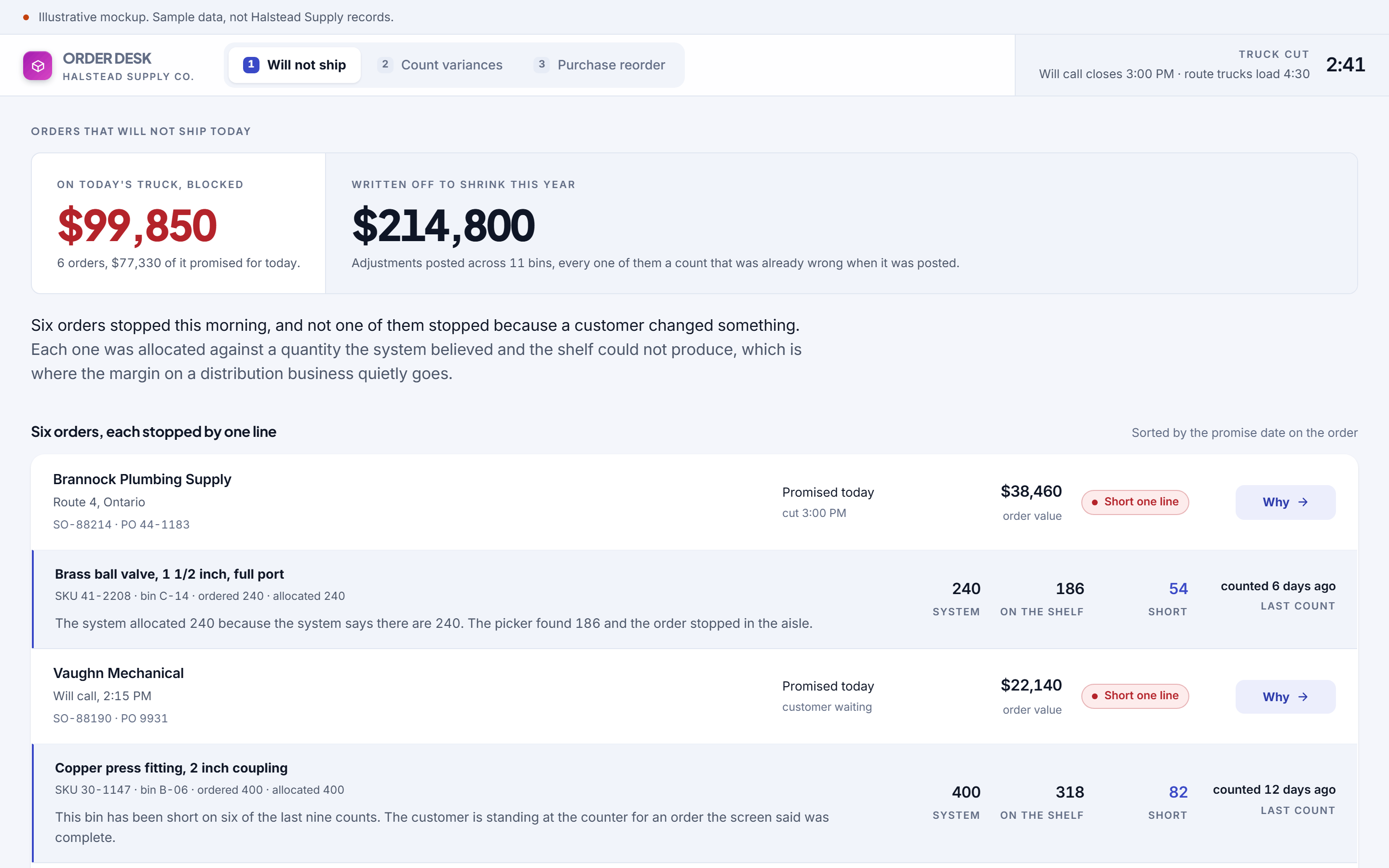
Six orders stopped this morning. Not one of them stopped because a customer changed something.
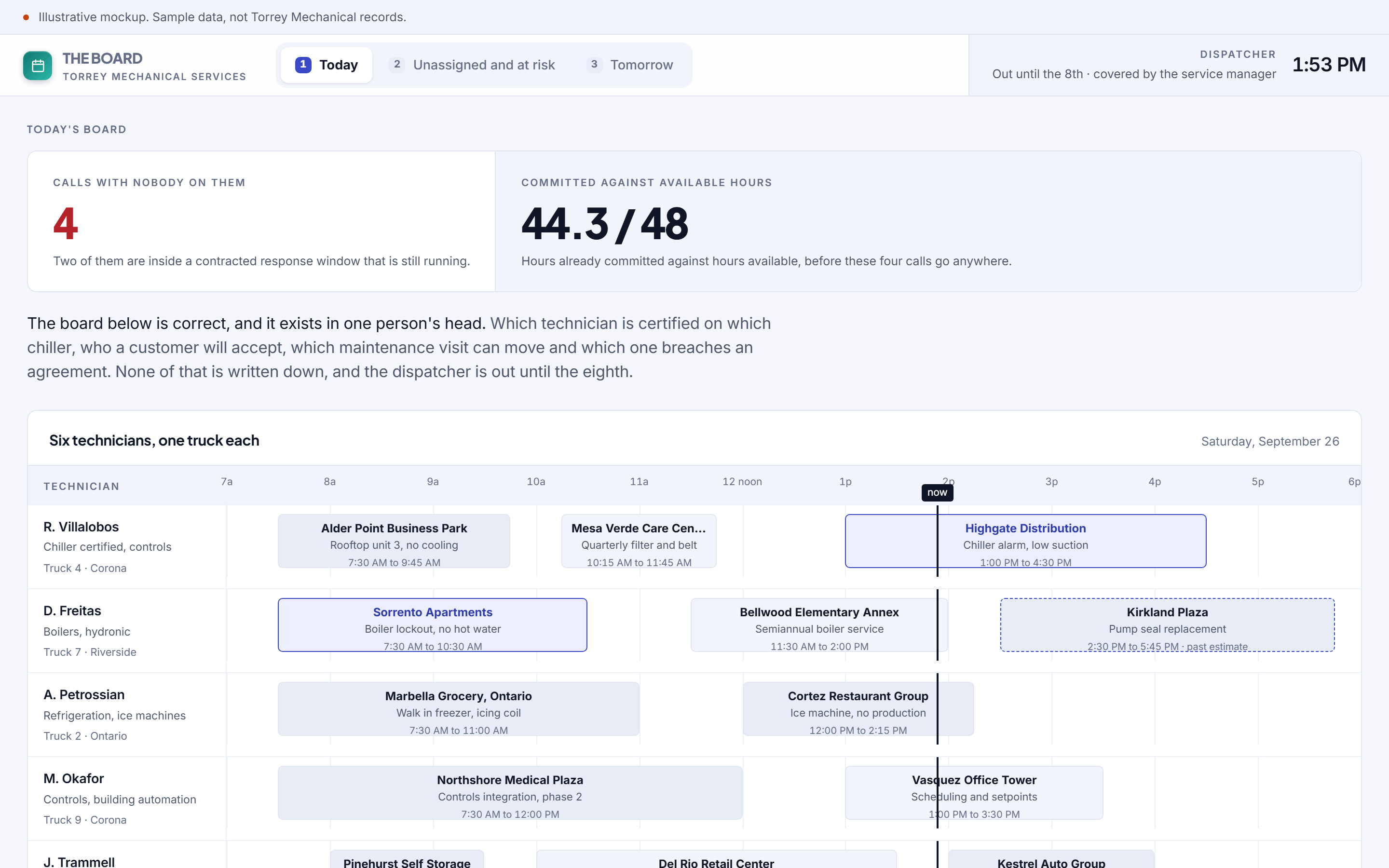
Which technician is certified on which chiller, which visit can move, which customer will accept whom. None of it is written down.
How we price, how long it takes, and who you get.
Fixed build, flat monthly
The build is one fixed price, agreed in writing before anything starts, with the scope written as screens. After launch, a flat monthly care plan keeps it running. No hourly billing, ever.
Weeks
From the first call to software running against real data with the people who will use it every day.
A dedicated team
Designers and engineers assigned to your project, with a named lead who owns delivery and sends you a written update every week.
What the care plan covers. Hosting, monitoring, backups and security updates, fixes when something breaks, and a set amount of small changes every month. Anything bigger is quoted as its own fixed price before any work starts. Care plans start with a 12 month term.
Built by people who have run these systems. Years spent building business systems for operations, finance and compliance teams, so the first version already understands the work.
Working software, not slide decks. You react to your own process on real screens within days, and the finished software lands in weeks.
A fixed price, in writing. Scoped as screens, not hours. If the scope changes, the price changes in writing before the work does.
One flat monthly fee after launch. Keeping the software healthy never turns into a surprise invoice.
Software people actually use. If it is slower than the spreadsheet it replaces, it has failed, so speed is designed in from the first screen.
You always know where it stands. A named project lead, a written update every week, and working software you can click rather than a progress report.
You own what we build for you. The code written for you, your data and the documentation, whether or not you ever call us again.
Private companies where one department runs on a process that outgrew its tools. The industry matters less than the pattern: a deadline, a queue someone works through, and a paper trail that has to hold up.
If nobody is doing the work by hand today, we are the wrong fit and we will say so on the first call.
No. Most projects connect to your current accounting and operations tools and replace the spreadsheets and manual steps between them.
You see a working prototype of your own process within days of the first conversation, running against realistic data rather than described in a document. The finished software follows in weeks.
The build is one fixed price, agreed in writing before building starts. After launch, a flat monthly care plan covers hosting, support and small changes. Anything bigger is priced in writing before the work begins.
You do. The code written for you, your data and the documentation are yours, and if you ever move on you take all of it with you. Shared building blocks we reuse across projects come with a permanent license to use them.
Your data stays in the software we build for you. AI features run inside that software, every suggestion shows its basis, and a person approves anything that matters. Hosting and data handling are agreed in writing before any work starts. We can host the software for you as part of the care plan, or run it inside your own cloud account.
Your care plan starts. We host the software, watch it, keep it secure and backed up, fix what breaks, and make small changes as your process shifts. What the plan includes is agreed in writing with the project, so you know before you commit.
Twenty minutes on a call. You will know what we would automate first, what it would cost and how long it would take.